Feast or Famine
by Gabrielle Fechter

My grandmother and I sit down to a nice dinner. We have tuna tartare, shrimp cocktail, Chateaubriand (beef tenderloin), mashed potatoes, and carrots. The meal was incredible. My grandmother and I have shared many meals like this. Even though my grandmother enjoys meals like this today, it is a stark difference from her childhood.

My grandmother, Claire, had a fascinating childhood. She is the first daughter of her parents, John and Wanda. Her father worked a myriad of jobs including being a World War I infantryman, a writer for several newspapers in New York City, a historian at the Picatinny Arsenal, a public relations director for a few companies, and at one point, a chicken farmer. He was often restless in his employment, and never really stuck at anything for long. Her mother was the daughter of Polish immigrants. As a child, my grandmother lived in Lafayette, Branchville, and Rutherford, New Jersey before moving to East Hartford, Connecticut when she was in high school.

My great-grandfather John was born and grew up in the United States. My great-grandmother Wanda was also born and grew up in the United States as well. Wanda, however, was the daughter of Polish immigrants, and all but one of her six siblings were born in Poland.

Wanda’s parents came to the United States shortly before Wanda was born. In his book Appetite City, William Grimes writes: “Poverty and political turmoil impelled Germans, French, and Italians in turn to try their luck in America, along with Hungarians, Syrians, Greeks, and, late in the century, Polish and Russian Jews” (85). Even though her parents were not Jews, they left Poland because of the same poverty and political turmoil. Wanda occasionally made some traditional Polish dishes, but this was quite rare. The one dish that my grandmother remembers eating as a child was creamed pearl onions, and this is something that my family still eats today. Creamed onions are a traditional English dish, which comes from her father’s side of the family. This dish connected back to his family’s homeland of England and fits in with the idea of that “there is no chef without a homeland” (Twitty 6). All food comes from somewhere. Even though some traditionally ethnic dishes remain essential for my family to this day, such as creamed onions, the central theme of my grandma’s story with food and her childhood revolve on class and economic factors.

In the United States, there are class distinctions. My grandmother’s family would have been considered the lower-middle class, and at times, poor. As a girl, my grandmother usually faced “feast or famine” depending on her father’s employment status. Because of their financial status, there was a worry about affording food. They faced food insecurity often. Sometimes they faced low food security, meaning at times her parents worried about having enough money for food, and at other times, they faced very low food security meaning at times they couldn’t afford enough food for everyone (Gunderson, Kreider, and Pepper 283).
Food and socioeconomic status are linked. The amount of money one has determines what a person eats. In the book, Distinction: A Social Critique of the Judgement of Taste, Pierre Bourdieu, a French Sociologist, discusses how food and social class are related. Bourdieu distinguishes between a taste of necessity and a taste of liberty:
“The antithesis between quantity and quality, substance and form, corresponds to the opposition-linked to different distances from necessity-between the taste of necessity, which favours the most ‘filling’ and most economical foods, and the taste of liberty-or luxury-which shifts the emphasis to the manner (of presenting, serving, eating etc.) and tends to use stylized forms to deny function.” (Bourdieu 6)
The distinction here is that those who are of a lower class have a “taste for necessity” meaning that they eat when they can afford and what will fill them up whereas those in a higher class have the luxury of choosing what to eat. Those who do not have a lot of money will pick cheaper foods because they need to eat because it is necessary.
Growing up, my grandmother fell into the category of fulfilling a “taste of necessity.” As my grandmother puts it “Most of the foods I ate growing up were based upon economic factors. We didn’t eat a lot of “fancy things” like steaks or roasts or that kind of thing.” My grandmother and her family ate based on necessity and what would satisfy their need for food.

The one surprising aspect of this however was that her family ate lots of fresh fruits and vegetables. Often, when families do not have a lot of money, they try to buy cheaper vegetables or no vegetables at all. John, my grandmother’s father, did not want to buy canned food so they opted for fresh. His aversion to canned food was that one of his relatives died and the official cause of death was canned tomatoes. People can die from botulism and from spoiled canned food. Therefore, her father avoided canned food at all costs.

On occasion, my grandmother and her family would get to have something fancy “sometimes, when we had money.” She recalls:
“I remember the very first time I ever had duck was because we all got to go out to dinner at this fancy restaurant at a lake not far from where we lived. My father suggested that I order duck because he thought I would really like it, which I did.”
This special occasion for my grandmother is something that she remembers to this day. One other fond food memory for my grandmother was eating capon, a fattened, neutered rooster. Her mother would roast one for a big fancy meal. These times were the good times.

The reality, however, was that there were a lot of bad times. Everything rested on her father, John. John was a kind man who cared deeply for his family, and my grandmother cherishes her memories of him, and expressed that she wishes he was still here today (even though he would be 119 years old!) The reality is that John’s actions dictated what the family had to eat. My grandmother said:
“My father was a wonderful man, but he was by far the world’s most awful budgeter. We either had lots of stuff, or we had nothing depending upon on what his working circumstances were at the time. I mean he had some really good jobs and life was really good, sometimes. But he also did some really stupid things, and life was horrible.”

There were a lot of bad times. My grandmother recalled one time where they were especially broke:
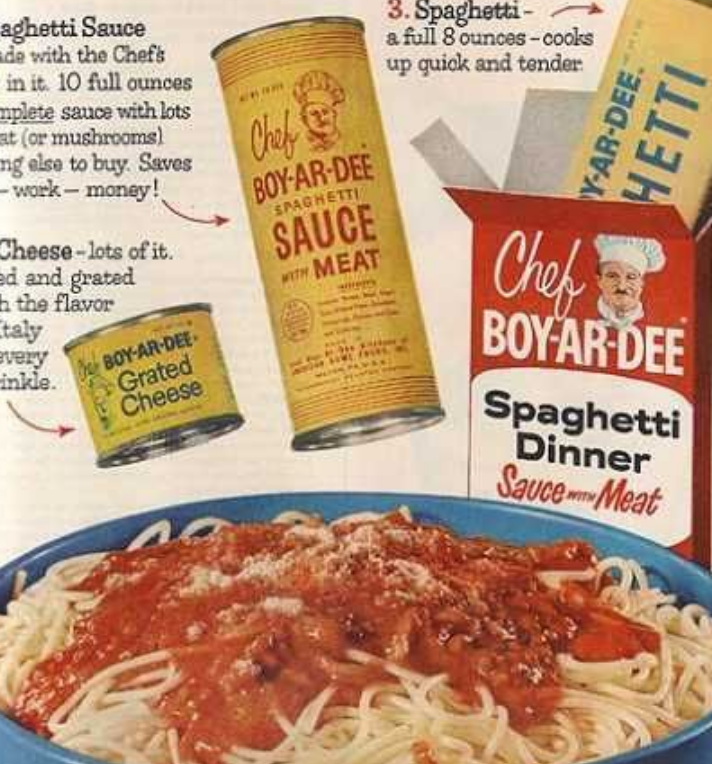
“The Salvation Army came and brought us a food basket, and in that food basket, I remember there was a regular box of spaghetti not like the little box of spaghetti in the Chef Boyardee box when you bought it, but a regular box of spaghetti like you would buy now.”
When my grandmother was growing up (during the 1940s and 1950s), Chef Boyardee came in a box with a box of spaghetti, a can of sauce with meat, and cheese; it was one of my grandmother’s favorite things. Besides the Chef Boyardee Box, my grandmother had never seen a box of spaghetti-like that one is found in a grocery store today. The Salvation Army bringing a basket with a regular box of spaghetti was both wonderous and humiliating, indicating to my grandmother how broke her family was.
John struggled from time to time with his own demons, but he did his absolute best to do what he could for his family. My grandmother believes he and her mother did the absolute best that they could, and in the end it all ended up okay. As my grandmother said: “So it was hard times, but it was okay, and we all survived, and here we are today.”
 | queens foodways |