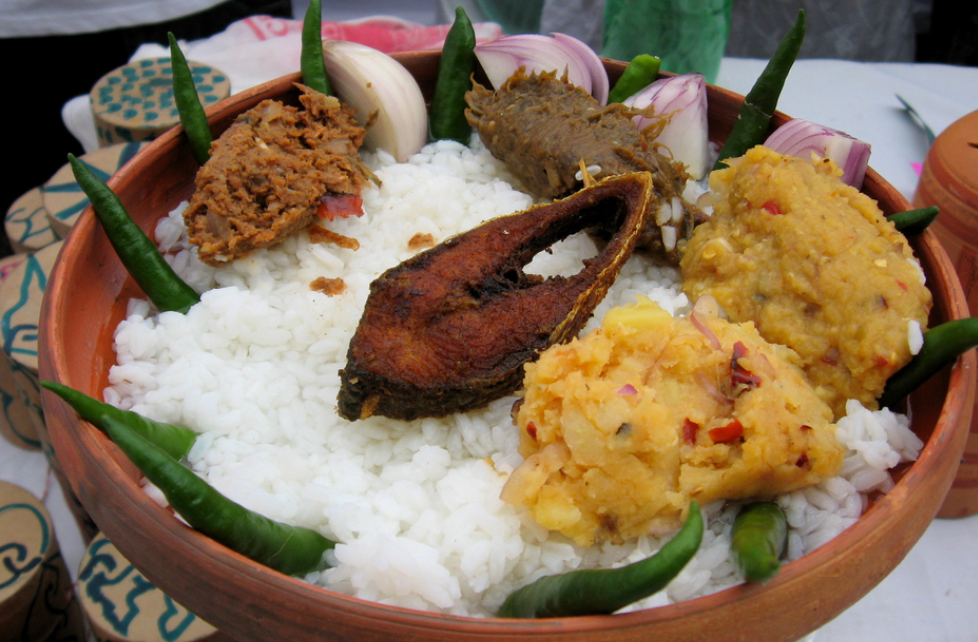
Bengali NYC
by Nishat Amin

Throughout this semester, I have been learning where my roots come from with all the classes I was taking this semester: psychology and English classes. I identified prejudice and discrimination within South Asian cultures from the in-group and out-group perspective, avert negative thoughts about the culture entirely, as well as I grew into respecting the upbringing of Bengali immigrants in New York City through food and ingredients as focuses. At the end of the semester, I have a different perspective and knowledge about my roots and a better understanding of my immediate family members and their upbringing. My interview entails of my mother, S. Amin, who consented in sharing her relationship with food and culture.

I am not close with my mother, S. Amin for some period of time. Ergo, requesting for her help and time was an awkward, dreadful moment. The whole tough love, mistrust, and miscommunication created a barrier between us. However, when it came to food, I am able to hold myself together and interact with her and not burst into rage. Since, she has been a housewife for a long period of time, she learned a lot of skills and dishes. I always asked for her knowledge and her answer to that would be “soon,” translating what she meant is when I am a wife myself. I had no intention of getting any information of her life because she believes in maintaining exclusive between herself and I, to assert authoritativeness. Based on my interview with her, I learned a few things about her and cooking Bengali cuisines.
Amin speaks fluently in Bengali, Hindi, and Urdu. Jamaica, New York has been her home for the last three decade, but she identifies herself a Bengali and vouches for where she comes from. She claims that she would return to Bangladesh in a heartbeat if she needed to. She has some knowledge of the English language but for her sake, I wanted her to be comfortable in conversing with me. I let her speak Bengali during the interview because it is her language that she is accustomed to.

The video starts with my mother saying she is hungry, as she just finishes cleaning the house and just taking a shower. I answered, “What do you want me to do about it?” Our relationship could be extreme in terms of emotions; I am sarcastic towards her, while she is apathetic towards me. However, because I have not asked her to help me with school or anything for a long time, that she was more excited than I was. She then said that she intends to share how she cooks Bengali cuisine, which I intervened and asked, “At what age did you start cooking?” From then, I started to learn more about her.

At the age of 23, Amin was starting to learn how to cook. It was a bit after her getting married but definitely after I was born in 1997. She then asked if she should talk about either rich food or vegetable-based food. Rich food consists of meat – chicken, beef, goat, and fish, but they contain butter, cream and other items that make the dish to have a heavy consistency. On the other hand, vegetable-based foods are self-explanatory and slightly healthier for people to eat. In Taco USA, Gustavo Arellano discussed how, “burritos were personal meals, meals of pain and embarrassment…” (Arellano, pp. 144), demonstrating that a culture’s food was ridiculed because it was different. It was the same case for Bengali students who brought home food such as curry to school and was mocked by other children. A chapter of a book called ‘the role of context in food choice, food acceptance, and food consumption’ discusses about the environmental factor in food consumption and acceptance (Meiselman, Herbert L, 2006). In class discussions, Spanish foods have become popular when non-Spanish/Hispanic people tried out their food. Accepting an ethnic food is also a step up in accepting and understanding the culture it comes from. Over the years, I had a decline of appreciation in what my culture entails.
I tried to not to speak as much but I believe she was not up for talking about the past without having specific questions. She talked about how-to-cook-kurma chicken. Kurma chicken is a chicken dish and one of my favorite Bengali food. We talked about the difference between a roast chicken and kurma chicken. She forgot how her older sister makes the roast. I asked what her favorite food is as she was about to eat and I tell her not to eat during the interview. She explained that she does not like to eat many things anymore, but she still loves beef, in which she explained how to make beef curry.

A 2008 study stated, “Migration to a new country often results in a variety of social and economic challenges, often reflected in foodways. Food is of central importance in maintaining connections to home, and signifying ethnic identity among diasporic community members. Alternatively, new opportunities may be represented by the incorporation of new food elements into consumption patterns” (Vallianatos, Helen, and Kim Raine, 2008). The reality is that ethnic food can be either valued or devalued, depending on economic values. Between the 1990’s and early 2000’s, there were few Bengali/Indian grocery stores in Queens. The fact that we lived in Jamaica, my father had to grocery shop for certain items all the way to Jackson Heights. Ethnic food can happen when it is accessible.
After explaining, I asked her, “Who taught you that?” She blushed and answered, “Billu chef” also known as my father. I asked her, “How would he know?” Not many men know how to cook. She explained that, “when he was unmarried bachelor and living in New York City, no one could have cooked for him.” After that she was done with the interview. It was no shock that my mother learned how to cook from my father, considering that there is a controversy between the gender roles. Many family members and friends tease about the fact that he can cook. (As if men can’t cook?) In Kitchen Confidential, Anthony Bourdain expressed he would rather eat a homemade food that is made with the love of a mother or grandmother. Bourdain and I both prefer a meal made out of love. Every Sunday, both my parents cook a meal together and bond over that, while satisfying my taste buds.

In the past, I did not approve of my mother interacting with others in her own language. A 2019 study observed that “concept of love and the significance of food in such a crucial manner that it has turned out to be nearly impossible to separate the one from the other” (Kumar, Rajneesh, 2019). As I have stated before, my relationship with my mother is an estranged relationship because of the tough love, mistrust, and miscommunication. Most parent-child relationship would be showing courage and expressing emotions, whereas I use food as a form of interaction and communication with my parents.

Right Photo: Bengali Wedding Party
 | queens foodways |