Everybody Has to Eat Everyday
by Nicolas Kuo
Something that I’m still working on doing is reconnecting with my father’s history. I’m fairly well-acquainted with my mom’s side; well, at least, I have more of an ability to speak fluently with my grandparents on that side. However, when it comes to my dad’s past, I’m not as informed. I wanted to interview my dad and get to know him a little bit better, and see if I could learn a little bit more about his immigration to the U.S.
When my dad first immigrated from Taiwan to the U.S. with my grandparents, they made the decision to open the restaurant in order to start their new life. “When you first come here as an immigrant in the 80s, in 1982, to be precise,” my dad started, “You have two options pretty much: open a laundry store, or open a restaurant. Agong thought about it for 2 seconds, and he decided to open a restaurant. When I asked him why, he said everybody has to eat, but not everybody has to do laundry every day.”
Thus, with the decision to open a restaurant made, my dad’s new life in California started.
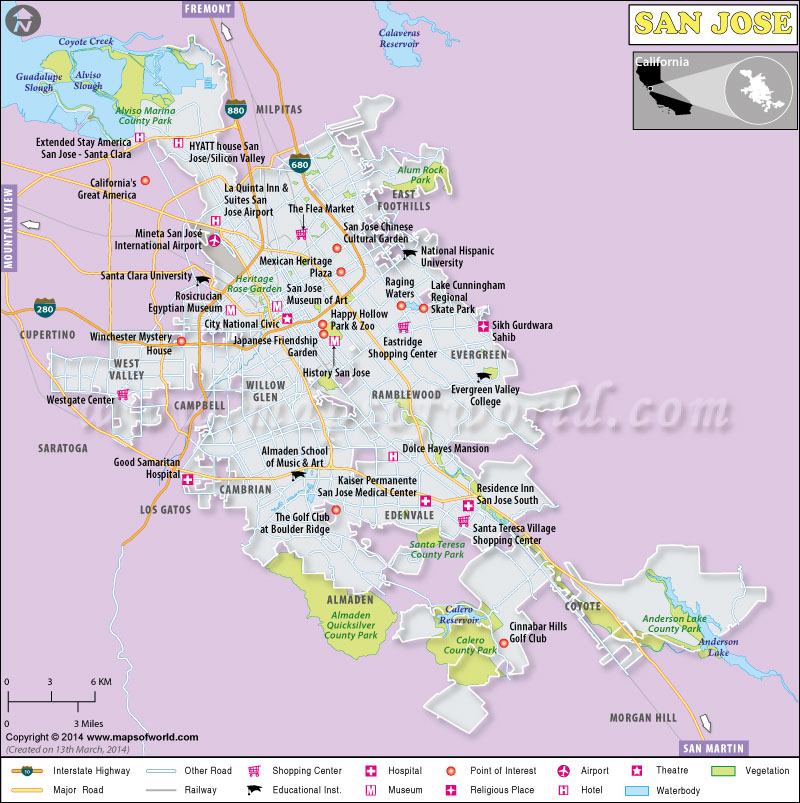
Everyone in the family worked. My grandparents, Agong (grandfather) and Ama (grandma), were in charge of making the food. Fried rice, chow mein, tacos, burritos, – surprised to hear these items, I cut my dad off mid-sentence, asking why they sold all these things. It turns out, my grandparents didn’t open up a new Chinese restaurant in California that neighbored an American restaurant called Sir Weiner, like I had thought: they had bought and taken over Sir Weiner when they decided to open the restaurant. “On the menu, there was already tacos, burritos, and uh, tater tots…and chili cheese dogs, and sauerkraut, and corn dogs, and when Mom and Dad took over, they added chow mein, fried rice, you know, it was pretty simple. Just fried pork, very simple, very very tasty.” My grandparents kept the old menu, continued making the hot dogs, the tacos, the burritos, the tater tots that the restaurant already made, but incorporated Chinese food that was simple to make as well. Thinking about it now, my grandparents very likely owned and operated one of the very first “fusion” Chinese restaurants; at their Sir Weiner, you could get American (maybe it’s considered German still at the time?) food, Mexican food, and Chinese food all under the same roof.
Hm. That’s a really cool thing to think about, the possibility that my grandparents owned one of the very first fusion restaurants in San Jose. Although, there’s definitely no way for me to be able to corroborate that, but based on my interview with my dad – it’s totally possible.
It led me to ask my dad if he ever made any kind of “fusion food,” since they were making a few different kinds of foods in their restaurant, and my dad told me about a wonton burger that he tried making – however, my imagination and his weren’t exactly on the same page. I imagined a burger that maybe had flattened wontons thrown in, kind of like a bacon cheeseburger that has strips of bacon inside it; my dad was a little bit more practical: it was just a fried wonton skin that was inserted into the burger. “We deep-fried the wonton skin and put it in the burger, and it worked out really good. I think people liked it. Some people started requesting it, and instead of cheese on the burger, we would put the wonton skin inside.”
And so, there is my dad’s mark on some type of Asian fusion food. A burger with a wonton skin inside.
The next question that I asked my dad was a little bit more related to who came into the restaurant, and the population that surrounded the neighborhood. The Bay Area of California is quite diverse; but it seems that the population’s diversity has somewhat stayed similar from when my dad first moved to the U.S., to when I was growing up. In the Downtown San Jose area, it was mainly a Mexican / Latino neighborhood, and these were the people who were attracted to the restaurant, particularly by the tacos and burritos. “They were about 60-70% of our customers,” my dad recalled. When my dad said that they were a Chinese-Mexican restaurant, I got really excited for a moment. I was hoping there would be more than them selling tacos and burritos, but unfortunately that’s what he meant.

My dad went further on, talking about the population that they served and the type of food that they made for the people. I was curious why they decided to make the more “American” Chinese food, and not the more traditional food. He actually said that the food that they served, he found it really awful, because it wasn’t good, and it wasn’t “real” Chinese or Taiwanese food. “Our Chinese food was awful. Just stupid things…sweet and sour pork, things like that. Really basic Chinese food. It’s like Chinese-American food, like Panda Express, it’s not really Chinese food.” Making real Chinese food was just impractical for the small restaurant that they owned, and my dad said it again just as much. “we are after all, a fast food restaurant, so you can’t really make traditional Chinese food, because it would require a lot of preparation, different types of material. Just too much work, and we can’t handle it.”
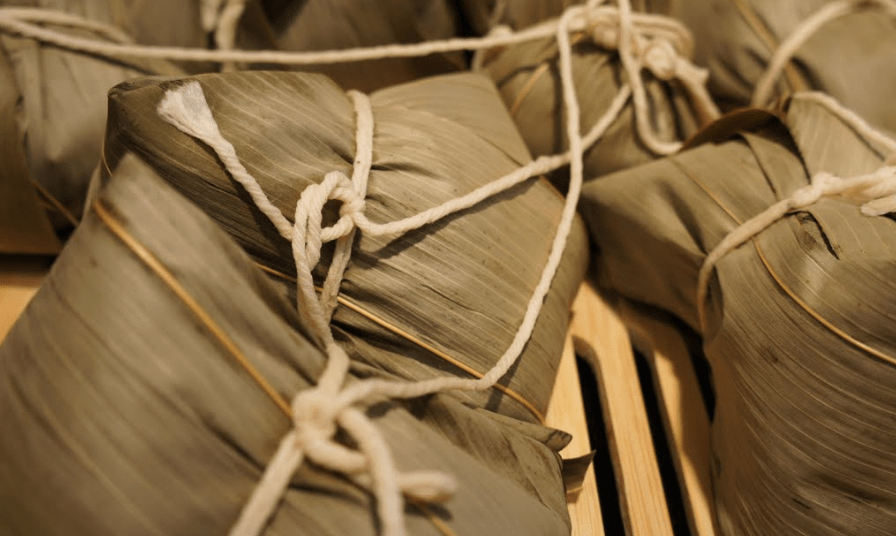
So, what was something that my Agong and Ama made at home that reminded my dad of home? I was really curious – day in and day out, seeing the same shitty Chinese-American food, and serving the American / Mexican food (despite my dad’s love of the tater tots and chili cheese dogs), what food really made him miss Taiwan? His answer was 粽子 (zongzi): sticky rice, or glutinous rice, which is wrapped inside bamboo leaves and served. Zongzi is a traditional Chinese sticky rice dish, but you can find it in other Asian countries as well – various names include lo mai gai (Cantonese), bakcang or bacang in Indonesia, Singapore, Malaysia, even Pya Htote in Burmese areas. The origins of zongzi, much like other Chinese foods, are rooted in a combination of mythology and history. However, regardless of its’ origin, zongzi is a dish that would be used to judge a chef’s cooking ability. “If you can make a good zongzi, that means you are a good chef. That’s almost like a gauge of how good of a chef you are. It’s hard to make a good zongzi,” according to my dad, and by this standard, my Ama is an amazing chef. I have never had the opportunity to try my Ama’s zongzi before; my dad says it’s a lot of work to make it, and it’s probably why she hasn’t made it for us before. Maybe when I go back to California, though, I might ask her to make some for me, and teach me how to make it as well.

This led to my final question for my dad: if they had the time to go out and eat, where did they go to get “real” Taiwanese food? His answer surprised me a little bit, because he said initially, there weren’t many options at the time. “There was mostly Vietnamese [food], right, ‘cause 82 was the height of the refugees coming from Vietnam to California, so there was mostly Vietnamese food in the area. Lee’s Sandwiches, Tonkee Noodle (both of which are very famous chains in the Bay Area now) came about around that time. There was not much authentic Taiwanese food. Nothing came until about 1995. Maybe there’s one in Cupertino. Mama Chen, I think that was the very first original Taiwanese restaurant.” It blew my mind a little bit that my dad had to wait 13 years before he found a place that could remind him of the country he was forced to leave. My dad has taken us to all these restaurants; restaurants, that until now, I associated with my childhood and places we would go to growing up, but never realizing that it’s these same restaurants from when he first immigrated here, that he grew up and witnessed become a part of San Jose history. In Michael Twitty’s The Cooking Gene, he says that his “entire cooking life has been about memory. It’s [his] most indispensable ingredient, so wherever [he] find[s] it, [he] hoard[s] it” (Twitty 31/573). I didn’t realize that every time my dad said he was taking us to one of his favorite restaurants, he was sharing his history with us through food. By taking us to eat at some of his favorite spots, my dad was trying to share his past with us. every I wasn’t able to get more photos that my dad might have had, because he couldn’t find them at the moment, but hopefully sometime in the future I’ll be able to see more photos from the time my grandparents owned their restaurant.
As we wrapped up the interview, my dad wanted me to make sure that I got the importance of food – it’s a time of gathering for our family, a time when all of us come together and spend time together, and always the time when, we always put our family first.
 | queens foodways |