A Never-Ending Food Talk
by Iris Wang
Interviewee’s Biography
Interviewee: Nguyen Thao Van

Preferred Name: Wendy
Gender: Female
Age: 22
Nationality: Vietnam
Place of Origin: Quang Nam, Vietnam
Current Address: Philadelphia, PA
Occupation: International student at Temple University, PA
Hobbies: Cooking, Traveling, Photography
Relationship with the interviewer: Friend and roommate since high school
This interview is conducted through facetime and the audio record is done on an iPhone 7.
Below is a list of questions that the interviewee answered during the interview. The article below may not address all of the interview questions.


Q: What kind/type of food do you identify with? If possible, which specific dish that you think can represent you?

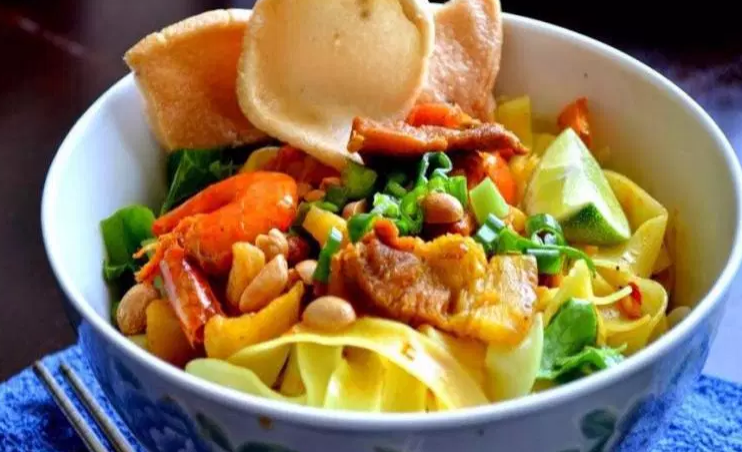
Wendy: Well, I think I am more, I think the food that I like may represent me the best are noodles. I like the type of noodle that has just a little bit of, you know like, broth in it. But the noodles have to go with some proteins. I like to have different types of proteins. I think a dish it’s easier for me (can represent me) is the noodle from my hometown. So, umm, it has just a little bit of broth, just a little bit of sweet flavor and it’s kind of salty at the same time. And there is a lot of meat. I don’t know how to associate with my personality, but everything is kind of go together and make a good dish in general. Because for the meat, you have the protein, the egg, the seafood, the broth is made of bone marrow. All of the flavors kind of like mixed up and create a good dish. And also the dish is served with crispy rice paper. So you know, this is the type of dish that I like and it could be a good representation of my personality.

So I am like funny, I am not really outgoing but I think if people get to know me. The first time I eat it, I don’t think I will like it that much. But the more you eat it, the more you like it because the flavors are mixed up together. It just like me, I feel like the people who meet me for the first time, they would not like me that much because I don’t speak that much for the first time. But when they start to know me more and more, I think they will enjoy being my friend.
Q: Tell me about your childhood in Vietnam. Is there any dish that stood out to you particularly? Why?

Wendy: Umm, I would say my childhood is kind of peaceful cause I live in a rural area. I think my childhood is filled with food because after my dad picked me up from kindergarten, we will always go out and eat. The type of food I eat the most, the one that has a long lasting memory to me was duck congee. Duck meat is cooked with rice. I eat a lot of other things too but this is the one my dad always takes me out to eat. My family doesn’t really eat out that much because my mom is a doctor. We mostly make food at home. If we have to eat out, we will usually eat at a restaurant that we kind of know for a long time. If we eat out, either because we were busy or the restaurant is really good. Most of the time we eat at home and we have family meals together. I think the reason why we like to eat at home a lot because this is Vietnamese people’s tradition and the food is easy to cook.
Wendy talks about her early life experience related to her eating habits as a Vietnamese. She points out a noodle dish from her hometown that can represent her the most in terms of personality or characteristics. I really enjoyed listening to her when she draws connections between food and her personality and family. In her opinion, Vietnamese food, the type of food that she identifies with, is a mix of flavors and this is what makes it shine. Since Wendy grew up eating Vietnamese food, a mix of characteristics branded every inch of her with the Vietnamese mark.
Here is a duck congee recipe recommended by Wendy and below is a duck congee taste test video:
Q: Who is the cook in your family? And who is the cook in your extended families? What did you notice? Follow up question: how did your parents learn how to cook?

Wendy: I think both of my dad and mom take turns to cook. In my family, we have a housekeeper. She cooks for the family sometimes. But mostly the food we eat is cooked by my parents, especially the fancier dishes. Both of my mom and dad know how to cook and they are good cooks I think. I think they both learned how to cook from the family. Both my dad and mom came from a big family. They have six or seven siblings. All the siblings in the family know how to cook because when they were little, they have to take turns and help their parents. This is how they learn to cook. Also, they (Wendy’s parents’ generation) grew up during the Vietnam War. At that time, parents are busy, if you grow up in a big family, then it is important for you to know how to cook. Also, my parents went to college and stayed away from home. They learned how to cook during that time a little bit too. Because going to college you have to know how to feed yourself. Especially during the war, I think in my extended families, the mother or the female cook the most. You know, in a traditional Vietnamese family, the woman’s role is to taking care of the family, taking care of the kids. Husband is the one who works.
I thought Wendy’s answer to this question is very interesting, as she mentioned at the end, in a traditional Vietnamese family, women do all the cooking and take care of the family. Normally, men don’t know how to cook because there is no need for them to know how to cook. In addition, in Asian culture, the idea of “man is superior to woman” is deeply rooted in people’s mind. Due to the Vietnam War, a major historical event, this idea is being left out in the margin. Every child in the family needs to learn how to cook in order to survive. Once the children are growing up and started their own family, they take turns to cook based on their availability. As the family becomes somewhat wealthier, they are able to hire a housekeeper and only cook “fancy dishes.”

What’s more, thinking about cooking and gender, it makes me think about one of the pictures from the Appetite City by William Grimes. In Chapter one, the city without a restaurant, “At their chophouse, the men presided over a no-frills dining room with a dingy bar up front and mahogany booths in the rear, John Brown, ‘a stout, burly, red-faced Englishman,’ stood at the head of a stairway in the middle of the dining room and carved the meat.” By looking at this picture and reading this quote, I think it draws the connection to what Wendy is talking about “the traditional Vietnamese family”. It is very fascinating to see that back in the days, no matter in Vietnam or America, they both share the idea of men is the superior and women is the inferior.

In addition, besides gender, I found another article that tells how Vietnam’s history influenced their food culture. In Life, Love and Pho by Mai Pham, “According to literary and historical accounts, the cooking and enjoyment of pho surfaced after the French occupation of Hanoi in the mid-1880s. The Vietnamese, who valued cows and buffalo as indispensable beasts of burden, ate little red meat and instead preferred pork, chicken and seafood.

But with the French affection for bifteck and dishes with boeuf, red meat began to appear in markets and restaurants and slowly influenced the Vietnamese diet, especially that of the upper class.” The creation of Pho has connections with both French and Chinese culture since both France occupied Vietnam for almost a hundred years, and China occupied Vietnam for a thousand years.
Q: Who taught you how to cook? How do you learn how to cook?
Wendy: Well, it is kind of strange because I didn’t learn how to cook from my parents. I learned how to cook until I came here. I remember when I was 15, I went to a boarding school, I went there but it’s kind of far from home. Every single week, my parents bring cooked food to me because I didn’t know how to cook. I raised in a family that my parents cook all the time. When I went to a boarding school, I didn’t prepare to learn how to cook. They prepared the meal for me and I just have to warm it up. When I came here (came to the U.S.), I lived in the dorm with two other Vietnamese friends… we cook some food in the rice cooker after dinner because the dinner offered from school not always fit our taste. We just cook some simple food such as soup with napa and shrimp, fried eggs with or without meat, stir-fried bok choy… Also cooking Vietnamese food, even though it takes a lot of time, it kind of bring us closer to home. If I was there by myself, I don’t think I will do it, but because I live with other Vietnamese friends, I think cooking helps bring us together and remind us of the culture that we grew up in. Especially for me, I would like to eat with other people because I like to eat with friends when I was young. Home is important and I can get a sense of it through cooking and eating with my friends.

It is very obvious that the family plays an important role in Wendy’s food journey. A reason why Wendy cooks is that this is a way to relate to her family and bring her closer to her family even though she is far away from home. This reminds me of The Cooking Gene by Michael W. Twitty, “The Old South is a place where people use food to tell themselves who they are, to tell others who they are, and to tell stories about where they’ve been. The Old South is a place of groaning tables across the tracks from want. It’s a place where arguments over how barbecue is prepared or chicken are served or whether sugar is used to sweeten cornbread can function as culinary shibboleths… We just know that somehow the table aches from the weight of so much… that we prop it up with our knees and excuses to keep it from falling.” Twitty also put emphasis on family culture and background and this is echoed to what Wendy said. When it comes to food, it is hard not to talk about the culture where a person is growing up with. Food helps us to get to know our roots better. In a similar way, only through knowing the culture, the family, the history, we can know our food better and learn to appreciate it.

Q: As you came to the U.S. at a young age on your own, how is the changing of location influenced your food journey? (in terms of cooking, eating habits, connections to certain food cultures, and so on)

Wendy: I think my taste kind of changed. I started not liking American food, until now, I feel like I am kind of comfortable with it. I wouldn’t say that I like it very much but it is not something I will refuse to eat. I also kind of accept the way Americans cook Vietnamese food too because there are some dishes that are different from what I grew up with. So the way they cook is kind of fusion. It is a mix between American and Vietnamese or Vietnamese and Chinese sometimes. Because most of the people who came here (the U.S.) have a half Chinese background. They came from the South (of Vietnam) so some of them are half Vietnamese and half Chinese. So, I feel like I am more comfortable now eating this kind of food. When the first time I eat it, this is not authentic Vietnamese food and how I grew up eating it. But now I understand it is hard to cook exactly what the dish suppose to be. There are a lot of ingredients are missing and hard to find. I accepted it and you can eat it, it is not that bad.
Q: As your roommate, we have cooked many dishes together from a variety of ranges, Vietnamese food to American food, main course to dessert. What are some of the factors that make you enjoy cooking so much?
Wendy: I think I talked to a lot of people and the one thing, in general, we as humans kind of share: most people say that it makes you relax when you cook. So, I feel the same way. When I take time and cook, I feel relax. Cooking involves science too. It is like working in the lab but less stress. If you mess a dish up, you still have chances to improve it. Eating it might be a pain because it might not turn out as what you expected. But I feel relief every time I cook. It helps me to know other cultures better. When I cook with you (Iris), you opened my eye to different cuisines and I get to learn a lot of cooking tips and tricks. Another thing I like about cooking is that you can go way above and beyond the recipe. You can change it depending on your taste. If you get really comfortable with one different you can add or change the ingredients to make it into what you want. This is something that I am not allowed to do in the lab.

As Wendy was talking, I suddenly remember one day when we were at grocery shopping. I saw the green mango and asked her how do you guys eat this. She said I will cook it for you. Then, she picked a mango to check out. When we came back to the dorm, she heated a small saucepan, in this saucepan, she put some fish sauce. She also asked me for some Laoganma, a typical Chinese chili sauce. Then, she also put in some sweetening syrup that she found in the sauce drawer. The heat helps the sauce mixed well. She also cut the mango into slices and grabbed one slice of mango and dipped it into the sauce and give it to me. The strong taste of the fish sauce really made me a little nervous at the beginning, but the more I eat, the more I get used to it and I ended up finishing the entire mango. Looking back at this moment, Wendy does not have the exact ingredients that she used back in Vietnam. Nonetheless, she worked with what she has, Vietnamese fish sauce, Chinese chili sauce, and American syrup, to recreate Vietnamese flavor. She was able to combine ingredients from three different countries to make it taste like home.
Q: I remember you told me that when you came to a Vietnamese restaurant in the U.S. for the first time and you were shocked by the pho, can you tell me more about that? How is it different from the pho you used to have in Vietnam/at home?

Wendy: When I first came here I was shocked by what they have here and they call it Vietnamese food because it is completely different. The pho is different because of the noodles. The noodles we had in Vietnam is thicker and longer. The way they cook it (in Vietnam), I feel like has fewer species than here (the U.S.). The quality of beef here (the U.S.) is better but the noodle is not the same. The noodle here is thinner and shorter, and it’s chewier I think. Back in Vietnam, it is not like that. I think the cooking process is pretty much the same in Vietnam and the U.S. You cook the broth with bone marrow, spices, and onion. Then you boil the beef and cut them into slices and eat it all together with the broth, noodle, beef, and some green vegetables. The noodle in Vietnam, restaurants make them freshly in the morning and this is not happening in the U.S.
Q: What is American food for you?
Wendy: I think a dish that stood out to me is burger because I grew up watching a lot of movies and I see burgers. In the movies, they didn’t talk about other dishes. So that is why that image kind of stick to my mind.

Q: In connection to the last questions, how do you define authenticity?
Wendy: I think it is hard to define it because it depends on individual standard. For me, I grew up in a different place. If I have to say a food is authentic, maybe my opinion will be different from my friend’s opinion who also grew up in Vietnam but in a different area. I think (authenticity) is how close the food it to your original dish. But I think if I have to make it less complicated, I will say, how you cook it and if you follow the recipe, it would turn out to be authentic but if you kind of change it to make it more comfortable to other people or Americanize/Westernize, it is not authentic.
Speaking about authenticity, if you haven’t seen my previous blog post on “Are you Eating Authentic Chinese Food?” then you are missing out! In this blog post, I highlighted a great article entitled Chop Suey as Imagined Authentic Chinese Food: The Culinary Identity of Chinese Restaurants in the United States by Haiming Liu. I like the way Liu describe American Chinese food as a negotiation between Chinese and American culture. Liu points out, “As an aspect of transnational culture, its authenticity and culinary identity often rested on its real and imagined Chinese roots, while its popularity depended on how well Chinese restaurant proprietors adapted the flavors, ingredients, and cookery of Chinese cuisine to the tastes and markets of local American communities.” Similar to American Vietnamese food or Chinese Vietnamese food, it is all about blending cultures together in a way that people from both cultures kind of accepting it.
Q: Do you think it is hard to stick with your Vietnamese culture while you are in the U.S.? If yes, in what ways? If no, why is that?
Wendy: It is hard for me to not to have my Vietnamese culture and totally immerse into American culture. Wherever I go, I still find myself as Vietnamese. Even though I live here for five years and I speak English here, but I still feel like I am more close to my root than ever. When I go out to eat, I still prefer Vietnamese or Asian food. When I cook, I still feel more comfortable cooking Vietnamese dish. I learned some other dishes too, but I am still more comfortable cooking Vietnamese food.
Q: How are non-Vietnamese people react to your Vietnamese food and culture? How do you feel when people rejecting Vietnamese food because they think it is weird or even disgusting?

Wendy: I have had some experience, either cooking my dish let people try or taking people out to a Vietnamese restaurant. So I want to make my dish really authentic and I usually have to add some “weird” ingredients (Iris: like fish sauce. Wendy: yeah). Sometimes people’s reaction is “oh, this smells bad” or “it tastes weird”. I think when I add shrimp paste, it smells really bad. I think I can stand it but probably not other people… I was really mad when people say my food is stink. I value food and I don’t usually say somebody’s food is disgusting even though it might not have a pleasant smell but it’s their food and culture so I don’t really say it. So that is the reason why I always expect other people to not say that. I was kind of embarrassed too cause maybe some people don’t know that much about our food. The first time they see it, probably they know that this is how they eat it.
The article When Little Island Cuisine Encountered Chinese Food by Pio Kuo talks about the term Ku-Shiang or Gu Xiang. In Chinese, it means hometown. “Ku-shiang expresses the intense homesickness felt by so many Taiwanese immigrants responding emotionally to the massive geographical distance between their homeland and their new land.” I believe food has a certain degree of connection to humans stomachs and personality. Everyone is raised in a certain environment by a certain cuisine. So, no matter where we go, we will never stop chasing our own roots, our memories of food, and the taste of home.
Q: Overall, what is Vietnamese food to you?
Wendy: Umm, that’s a good question. Vietnamese food to me, I think it’s a bit hard to define it because.. I think I would say some dish when people say I would recognize directly. I don’t know. I think it is about the food that I try before. It’s kind of hard to define it.

I felt very privileged to be able to listen to Wendy and conduct this interview. Through this interview, through the dishes and stories that Wendy shared, I get to look at Vietnam through different lenses, in terms of culture, history, eating habits, and migration. As friends, I really appreciate Wendy is willing to take her time and talk about her food journey because I felt like I have been benefited from it greatly.
Wendy, if you are reading, I want to express my sincere appreciation to you as we are entering our sixth years of friendship. Having you as my best friend is my honor and I precious every wonderful moment that we shared and will be sharing. Words just cannot express my gratefulness to you! Lots of love to you!
Coming back to food, food is not only something to fill our stomach but also is closely associated with emotions, feelings, and people. What behinds every cuisine are culture and history. Different cuisines and different dishes can blend multiple cultures and emotions together. Everyone should be grateful for all kinds of delicious cuisine in the world because there is a story behind each and every dish or even every condiment. They are well deserved to be respected, heard, and passed on.
Works Cited
Grimes, William. Appetite City: a Culinary History of New York. North Point Press, 2010.
Kuo, Pio. “When Little Island Cuisine Encountered Chinese Food.” Find in a Library with WorldCat, 15 Apr. 2019, Web. 24 Apr. 2019.
Liu, Haiming. “Chop Suey as Imagined Authentic Chinese Food: The Culinary Identity of Chinese Restaurants in the United States.” Journal of Transnational American Studies, 16 Feb. 2009, Web. 8 Apr. 2019.
Twitty, Michael. The Cooking Gene: a Journey through African American Culinary History in the Old South. Amistad, an Imprint of HarperCollins Publishers, 2018.
Pham, Mai. “Life, Love and Pho.” Los Angeles Times, Jul 16, 1997, pp. 3-H, 3:1. ProQuest, Web. 23 Apr. 2019.
Van, Nguyen Thao (Wendy). Personal interview. 20 Apr. 2019.
 | queens foodways |