An Interview with an Expert
by Alexander Giller
Here’s the audio from the interview so you can follow along
Now to preface this, this interview isn’t the longest one I’ve conducted it was more or less a casual conversation between me and the interviewee although for the recorded part of it, there wasn’t as much interjection from me.
I will say, it only makes the most sense that while we’re talking Filipino food… We eat… Chinese food! Wait what? Yeah it was after a long work day for my interviewee and day of traveling around for me, so we wound up getting some Chinese food from a couple of different places.


For starters, the person I decided to interview was my Aunt Rosalie Faeldonia. She isn’t too traditional of a cook but as someone who grew up in the Philippines herself I figured she was qualified enough to talk about Filipino cuisine with and she has some interesting favorite dish
Her favorite dish is a Filipino Dish called “Kare kare” it’s a sort of stew with Oxtail in a type of peanut sauce, pictured below.

Interestingly enough this Dish has it’s origins dating back to before colonial powers came to the Philippines. Though there isn’t just one story on the matter so it’s hard to know which one is correct. there’s claims it comes from around the Spanish era as well and that the Japanese brought it to the Philippines, while it’s history is rather unclear, this dish does hold significance to my Aunt as her favorite dish.
Interestingly enough it wasn’t till she was in college in the United States that she came upon this dish and found she really liked it despite not normally liking saucy type foods. She found out it was the only Filipino dish that used any kind of peanut sauce and that’s when she really wanted to try it. Which, this dish is made with a meat that most people wouldn’t even want to eat. The meat being the tail from a cow, often called Oxtail. But my Aunt still loved it regardless.
This is reminding me of Anthony Bordain’s book “Kitchen Confidential” when he tried that first Oyster. It makes me wonder if my Aunt had a similar experience to when he had first tried his going into such details as to describe how others around him were reacting to it.. I imagine it might not have been such as big of a moment as Bordain’s, moment of realizing that “Everything was different now. Everything. I’d not only survived– I enjoyed.”
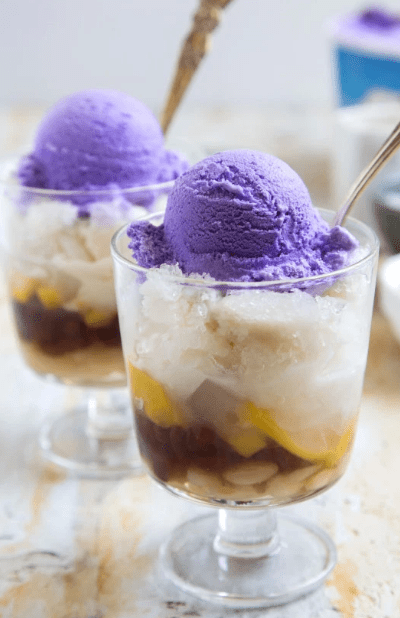
Continuing from this, my Aunt also tells me of her favorite dessert, it’s a cold dessert called Halo Halo (Or HaluHalo).

Halo Halo is a mix of beans, Taro beans, moon beans with some ice cream, milk and coconut with a lot of ice. Usually all this is topped off with some flan. It’s called Halo Halo because you mix it before you eat it usually. The name of the dish literally translates to Mix-mix and it’s a popular summer dish.
Which upon doing some light research on Halo Halo, the dessert has it’s roots in Prewar Japan. In which the Philippines indigenized the Japanese dish, Kakigori. Which one piece that the Philippines was lacking was the ice, which wouldn’t come until the United States brought it over. There’s actually several different variations of Halo Halo around the region, like from Thailand and Vietnam.

Which if we’re gonna tie things into what we discussed in class a little more, Anthony Bordain even gave this dessert a shot from a Jollibee restaurant. He had this to comment about it, “It makes no goddamn sense at all. I love it.”
The next question I asked was a bit more of a personal one, “When did you learn how to cook?”
To which my Aunt answered that she didn’t learn to cook back in the Philippines. Which to provide some context, I know from many stories my Mother told me when I was younger that her side of the family grew up on a farm in the Philippines before eventually moving to the United States. They still own the land back in the Philippines and come to visit whenever they can.
But to get back to the question my Aunt Rosalie explained that she didn’t learn how to cook till she got married and had kids. She mostly used the internet to learn how to cook as well as she has. Which makes me wonder what recipes she has used and where I might be able to find them. My Mom is a similar case in that she didn’t get too into cooking till she had my brother and I. Which even nowadays she still loves to experiment around with her cooking.
Which if we’re talking specifically about the kinds of content my Aunt Rosalie used for cooking, she did tell me that she prefers to use recipes that are shown in videos. Which I will go on record to say one of the favorite things she makes that I love having whenever she makes it, is Spanish Sweet Bread. Well there’s a Filipino variant on it of course, and it always turns out amazing whenever she makes it. This could be the recipe she used, or it could just be close, but this does look pretty close to the one she makes so I have my suspicions.
Overall, I’m glad I had this little conversation with my Aunt about the food she loves and how she started her cooking. I know this isn’t the most exciting of interviews, but this is still one I’m glad I had.
 | queens foodways |