Guyana/Suriname Meets Queens, NY
by Ashley Michel
In an earlier blog post this semester, I featured a post on “How to Make Goat Curry from the “GOAT.” I am not referring to an actual GOAT here, but The Greatest Cook of All Time, my boyfriend’s mother, Yasmin. Her cooking is amazing and I thought she was the perfect fit for this task of discovering food. Of course, my favorite dish of hers is goat curry. In a previous conversation with her, I was under the impression that she had a set recipe in the back of her head to make this dish. When I asked her how to make it, it seemed as though she knew exactly how much of each ingredient she uses each time. Unfortunately, I had to cut my phone interview time with her in half as she was travelling back home to Guyana for a funeral the day before I was scheduled to interview her. However, I was still able to get some valuable information from her.

Pictured is a Map of Guyana
Many individuals identify with specific cuisines and we are usually able to tell a story about that food and its culture (Mills). I think it is important to note here that we can identify with any cuisine, but we don’t necessarily have to be of that culture. This is very similar to the idea of assimilation and language. I have an adopted cousin who is Cambodian, but she was raised by Haitians who spoke Creole to her at a very early age and the food she identifies with is Haitian food and not necessarily Cambodian food. Through interview research we are able to get first-hand information about the food and culture of individuals personally.
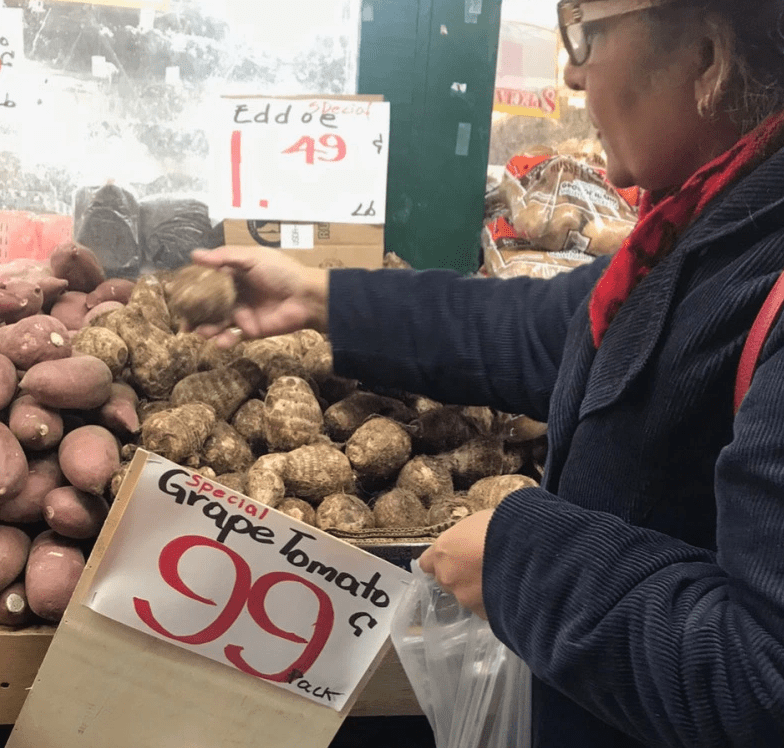
Yasmin was born and raised in Eastern Guyana. She was a seamstress in Suriname so she spent quite some time away from home and she eventually lived there permanently. She came to America in October 2011 with her husband and son. Her main purpose for coming was to seek better opportunity for son and her family. She wanted to be able to provide for her family back home, while working here. Through this short interview, food has helped her to cope with the longing for wanting to be back home. After 8 years, she has returned back twice, this time being the third to visit sick relatives, attend a wedding, and a funeral. While these may not all be happy moments, she recounts that she misses the food back home and the way of life. Where she was raised was a residential area, with very little farming. Her dad did occasional farming planting spinach, celery, and tomatoes, from what she recalls. Her task was to water and help pick these plants. Her mom would then sell these goods, but it wasn’t a business they had. It was a means to generate income to buy other goods. Aside from planting and farming, they would go to the supermarket. It is not like the KeyFood or Foodtown we have here in America.
“Back in the days it was markets on the road that were reasonable prices at the time. It’s like a flea market.”

Yasmin is picking out eggplants.
Much of the food we eat every day is processed. Yasmin notes that the “quality of the food is more natural, it’s fresh, and you get more nutrients.” While we may have chains like Trader Joe’s and Whole Foods advertising “organic” foods, there are some sorts of chemicals used to keep these fruits and vegetables fresh for long periods of time. She learned how to cook by watching those around her. She says that she had no access to the Internet at the time and her line of thinking is congruent to that of Michael Twitty’s. He says, “There was no Internet to look up what a food or an ingredient was, or to diagnose its provenance. You were simply told – in another language – to sit down, shut up, and eat what’s offered to you, and don’t be rude and refuse it” (Twitty, 66). Luckily, in the modern era that we live in, we can easily go on YouTube and look up a recipe to follow. Also, we have access to many cooking shows on the cooking channel. Bourdain says, “And I’ve long believed that good food, good eating, is all about risk” (Bourdain, 6). Yasmin has taken many risks in trying to learn how to cook. She describes it as a trial and error phenomenon or almost like riding a bike. One keeps trying to learn until he or she finally gets it. One particular ingredient she uses when cooking all the time is Ajinomoto, which she uses mostly in meat products, curry, and soups.

This is the ingredient she uses most when cooking.
To answer the question that Zacarhy Nowak poses in his study, ““If taste isn’t necessarily linked to the place where a particular food is born, what do you think about the inevitable adaptions (some would call them “corruptions”) that happen when food travels far from home” (Nowak, 3). Essentially, food travelling from home is a positive force. I posed Yasmin the question of whether she thinks Guyanese food is more accessible than Surinamese food.
“There is more Guyanese people in the states and not many Surinamese people have moved here.”
I told her that she can perhaps start the movement for Surinamese food, at least here in Queens, NY. She laughed almost as if it seems impossible.

Yasmin is picking out bitter melons.
I think it is safe to say we can remove skepticism if the person serving us food is not of that culture. Perhaps, the person serving us this food is simply doing their job and it is indeed made by a specific person from a specific culture. Region doesn’t make foods taste differently. For instance, think about when you go to a catered event. The one that comes to mind is going on a cruise. One night, they had Caribbean night and the food was being served by all different kinds of cultures. I was able to confirm the food was made by a Caribbean native from Jamaica because he came out the kitchen the last night of the cruise to greet the crowd. This just reveals food as another measure for opportunity.

Yasmin is choosing Sour Sop.
Religion and food came up in our conversation. She is Muslim and their meat must be consumed Halal. That is they pray over the animal before they kill it. I was curious to know whether Halal meat alters the flavor of food, but it does not. Also, here in America, Halal meat must be bought at the poultry, but back home she is able to kill the animal right in her backyard.

Pictured Here is the Halal Poultry that Yasmin and her family like to go to here in NYC.
Much of our conservation rests in the disparities between accessibility in America and Caribbean countries.

Yasmin picking out more cooking ingredients.
Works Cited
Bourdain, Anthony. Kitchen Confidential: Adventures in the Culinary Underbelly. Updated edition. [New York]: Harper Perennial, 2007. Print.
Mills,Richard J.,,Jr. (2018). An analysis of the common rhetoric surrounding cuisine identity. American Journal of Management, 18(1), 76-83. Accessed April 9, 2019.
Nowak, Zachary, and Antonio Mattozzi. “Interview with Antonio Mattozzi, Author of Inventing The Pizzeria: A History of Pizza Making in Naples.” Gastronomica, vol. 15, no. 4, 2015, pp. 1–5. Accessed April 9, 2019.
Safi, Yasmin. Personal Interview. 16 April 2019.
Twitty, Michael. The Cooking Gene: a Journey through African American Culinary History in the Old South. Amistad, an Imprint of HarperCollins Publishers, 2018.
 | queens foodways |